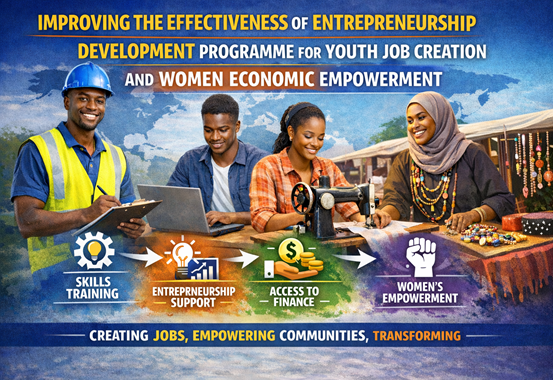
PROGRAMME FOR YOUTH JOB CREATION AND WOMEN ECONOMIC EMPOWERMENT;
SOME EVIDENCE BASED INSIGHTS FROM NIGERIA
INTRODUCTION
Youth unemployment has today become one of the most intractable development problems facing the global community. The timid recovery of most economies from the 2008 Global Financial Crisis and the devastating impact of COVID-19 Pandemic on the labour market, further aggravated the challenge of Youth Unemployment. The employment prospects for the youth are not cheering even when these young ones are armed with strong university Degrees.
(ILO, 2026), in its Employment and Social Trends 2026 Report, has some chilling revelations on youth unemployment.
Labour market conditions for young people remain problematic, especially in low-income countries. In 2025, the organization noted that the global youth unemployment rate moved up to 12.4%, form 12.3% in 2024.
While higher education holds the promise of obtaining better jobs more easily, it does not always lead to lower youth unemployment rate.
Progress in labour market condition for youth is stagnating. In 2025, the share of youth not in employment, education or training (NEET) reached 20.0%
Similarly, studies and experience have shown that women globally, are the most marginalized in terms of labour market participation, sustainable livelihoods and income generation.
2025 FACTS AND FIGURES FROM UN-WOMEN:
- 1 in every 10 women is living in extreme poverty globally
- Women are less likely to have access to social protection
- Women are slightly more likely to be unemployed than men
- Women remain less likely to participate in the labour market than men around the world.
- Women are over-represented in informal and vulnerable employments (60% globally).
- Women are less likely to be entrepreneurs and face more disadvantages starting business.
2024 STATISTICAL PORTRAIT
- Share of youth not in employment, education or training (NEET) in 2023, was 20%
- 2 in 3 young NEETs globally are women
- 1 in 3 youth live in a country that is (off track) for the Sustainable Development Goal (SDG) target 8.6, which sought to reduce substantially, the share of young NEETs by 2020.
- 1 in 3 youth in Arab states and North Africa, are unemployed
- 3 in 4 youth in Sub-Saharan Africa, lack secure work.
- 2 in 3 young people globally, are worried about losing their jobs (Rising Youth Anxiety Levels).
Research and experience have revealed that several efforts at putting youths to work have not been effective. Reason being that actionable, implementable, creative, sustainable and youth-friendly solutions have been scantly deployed in addressing Youth Job Creation. In corroboration of our finding, Jonas Bausch (ILO Youth Employment Specialist) commenting on existing frameworks and mandate on youth unemployment in Africa, notes that “past and current programs have not yielded sufficient result/impact”(ILO & AU, 2023; Africa: YES we can! AU-ILO Youth Employment Strategy for Africa). Also, the weak private sector we witness today in most economies, has limited the sector’s capacity to create jobs for the youths. Several nations have deployed Youth Entrepreneurship Development Programming as one of the best Active Labour Market Policies (ALMPs) for addressing rising youth unemployment, youth job creation and transitioning youth from Education to work.
Our motivation for this brief write-up is to share some of our evidence-based insights that can strengthen nations to rethink their Entrepreneurship Development Programming Model for youth job creation and women economic empowerment.
PROGRAMME UNDER DISCUSSION:
In 2021, MasterCard Foundation, flagged off a 5-year programme (2021 – 2025), tagged Transforming Nigerian Youth, anchored by: The Enterprise Development Centre (EDC) of the PAN-ATLANTIC UNIVERSITY in Nigeria.
The programme was aimed at helping Nigerian Youth(male and female), aged between 18 to 35 years who are already in business or are showing interest in starting one. The program was to build their capacity, develop their entrepreneurial mindset and help them run successful businesses that can create decent jobs. In our assessment, the programme was a huge success. It created thousands of youth entrepreneurs equipped with cutting-edge skills in small enterprise development and management. This resulted in huge job creation by these youth business operators. This Model of entrepreneurship development programming for youth job creation, was premised on the following success fundamentals:
- A transparent non-bureaucratic selection process devoid of political and elite-capture.
- Inclusivity was deployed by the Enterprise Development Centre, the anchor institution.
- Inclusivity here went beyond gender sensitivity and embraced what we chose to call locational inclusivity – youths in urban areas, youth in riverine areas, even youth in conflict-affected areas of Nigeria.
Also, youth with disabilities were given special attention. It was a nationwide programme.
The selected youth underwent strong virtual training in various business skills to prepare them for onboarding with Business Development Service Providers (BDSPs).
Because we know that young people face greater barriers in starting and running their own businesses, groups of these youths were assigned to or paired with various highly skilled, experienced and youth-friendly Business Development Service Providers (BDSPs) who were to guide, train, mentor, coach and motivate them to ensure business success and sustainability.
A key take-off engagement of the BDSPs with their mentees was to understudy, understand and assess their businesses to be able to know the solutions to deploy during the interventions. The BDSPs were expected to give their mentees value-adding entrepreneurial and mindset orientation that will enhance the success of their business.
The selection/hiring of the BDSPs was transparent, merit-based and without bias, gender or otherwise.
The programme ensured that where the need arises, the mentee is supported to undergo an internship program that will give him or her hands-on experience that will strengthen his or her business operation and success.
Because we know that most youth operate their businesses in the informal sector, the participants of this programme were helped to formalize and properly structure their businesses. Their businesses were registered with the Corporate Affairs Commission of Nigeria, courtesy of MasterCard Foundation/EDC at no cost to them. They were also guided by their BDSPs to address other regulatory challenges that could hinder their business success and growth
These youth business operators were encouraged to have strong social media presence for their businesses in order to enhance their market reach, visibility and proper market positioning for their businesses.
The programme ensured that the participating youth were equipped and trained by their BDSPs to make them investment-ready. This includes: helping them with Business Plan development skill and Pitch making
Bespoke training modules were developed for youth participants with disabilities. The training was not a one-size-fit-all-approach.
Strong monitoring and evaluation was deployed by the anchor institution (Enterprise Development Centre, EDC), to keep the program on track and check deviations from the program objectives.
Strong ethical standards were deployed in implementing this programme.
In conclusion, entrepreneurship development programming, effectively, creatively and innovatively driven, can be a game-changer and sustainable pathway in youth job creation. We strongly believe that this evidence-based insights, can be replicated with great success, by other nations, and agencies, given appropriate and enabling youth entrepreneurship development ecosystem.
Providing decent and sustainable jobs for our youth is non-negotiable.
Young C. Okezie, PhD, FCA, FCDA, BDSP, is the Chairman, Research, Innovation and
Professional Development Committee, as well as a Council Member of the
Chartered Institute of Development Studies and Administration of Nigeria (CIDSAN).